
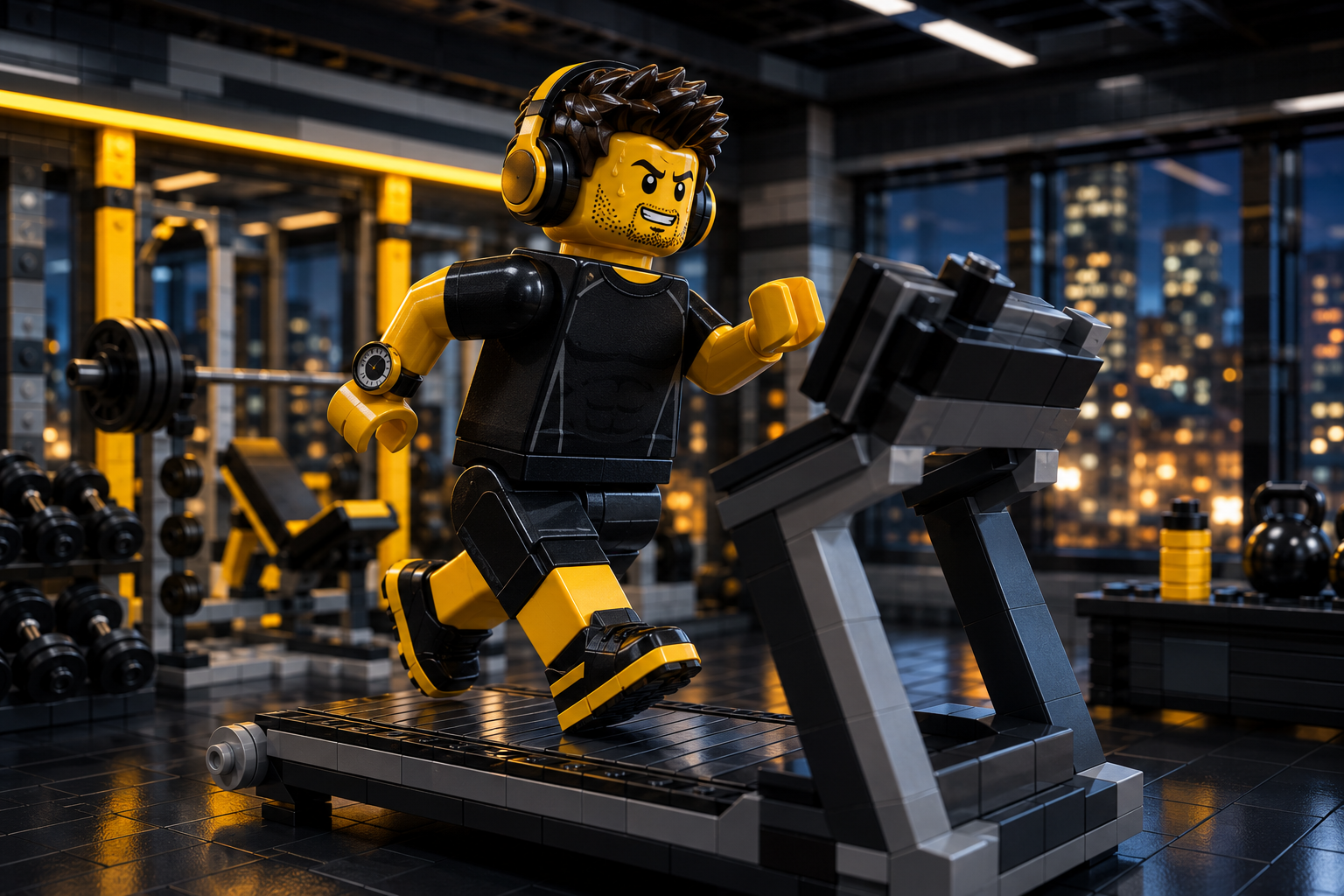
Some songs accompany a run. Others seem to push the runner forward from behind.
The tracks below belong to the second group: aggressive drums, compressed guitars, explosive choruses, and tempos that work particularly well during tempo runs, interval sessions, and those final kilometers when the legs begin negotiating an early surrender.
The BPM values are approximate, as different software may interpret a song’s pulse at half-time or double-time. More important than chasing an exact number is understanding how naturally the beat connects with your stride.
1. Green Day — “American Idiot”

Approximate tempo: 186 BPM
Best suited for: Short intervals, accelerations, and the final kilometer.
The song offers virtually no room to breathe. The drums feature a powerful snare on beats two and four, while the guitars use short, consistent power-chord attacks. Together, they create a clear rhythmic reference that can be easily associated with a runner’s stride.
What happens in the studio…
The album was produced by Rob Cavallo and Green Day. The drums were initially recorded on two-inch analog tape and later transferred to Pro Tools. This allowed the production team to combine the tape compression and saturation with the flexibility of digital editing.
Tré Cool reportedly brought dozens of snare drums to the sessions, searching for the precise attack required by each song.
The drums were also recorded in a room with a high ceiling at Ocean Way Studio B. Its natural acoustics helped create depth without sacrificing aggression. The result is a massive drum sound in which every hit remains remarkably clear.
Billie Joe Armstrong discusses the making of the album in this interview.
Interesting fact:
Green Day had been working on another album, titled Cigarettes and Valentines, when the master recordings disappeared. Instead of simply reconstructing the lost material, the band decided to start again.
That crisis eventually gave birth to the idea of creating a “punk rock opera”: American Idiot.
Why does it work for running?
At 186 BPM, the song may allow faster runners to match one step to each beat. At more moderate speeds, runners can follow only the strongest rhythmic accents without artificially changing their natural mechanics.
2. Foo Fighters — “The Pretender”

Approximate tempo: 173 BPM
Best suited for: Tempo runs, progression runs, and moments when the urge to slow down begins to appear.
The brilliance of “The Pretender” lies in its contrasts. The introduction is restrained and tense. Then the drums and guitars arrive as if a dam has suddenly burst.
This alternation creates anticipation, releases energy, and produces a continuous sense of forward motion.
What happens in the studio…
Produced by Gil Norton, the track was mixed by Rich Costey. During the mixing process, Costey worked with multiple guitar layers, parallel compression, and automation to ensure sections expanded without turning the entire recording into an indistinct wall of sound.
Instead of keeping every element at maximum intensity throughout the song, the mix repeatedly opens and closes sonic spaces.
That is precisely what makes the chorus sound so enormous: its impact comes from the contrast between sections rather than volume alone.
The mixing process was examined in detail by Sound On Sound in an interview with Rich Costey.
Interesting fact:
Dave Grohl has explained that the lyrics grew from the feeling of confronting people and institutions that attempt to control or silence others.
The title refers to someone who pretends to be something they are not or occupies a position they do not truly deserve.
Why does it work for running?
Its tempo sits close to the cadence naturally adopted by many runners. The gradual crescendos also provide excellent musical landmarks for spontaneous accelerations.
3. Paramore — “Misery Business”

Approximate tempo: 173 BPM
Best suited for: Fartlek sessions, fast workouts, and shorter runs.
Zac Farro’s drumming is agile and full of subtle anticipation. The guitars alternate between palm-muted passages and open chords.
This movement between restrained and released sounds creates the impression that the song is constantly leaping forward.
What happens in the studio…
Producer David Bendeth wanted to preserve the band’s youth and urgency while creating a recording polished enough for radio.
Hayley Williams’ vocals were carefully doubled in selected sections, while additional harmonies enlarge the choruses without removing the personality of the main performance.
The guitars were layered to create stereo width. Similar performances occupy the left and right sides of the mix, allowing the bass, kick drum, snare, and lead vocals to remain firm in the center.
Bendeth revisited the making of Riot! in this interview marking the album’s tenth anniversary.
Interesting fact:
“Misery Business” nearly didn’t make it onto Riot!
The band arrived at the studio without the song being completely resolved, but the producer immediately recognized its potential. It eventually became the track that introduced Paramore to a global audience.
Why does it work for running?
Its tempo encourages the runner to connect stride and rhythm. The drum fills also introduce small changes that help prevent an intense training session from becoming monotonous.
4. Mötley Crüe — “Kickstart My Heart”

Approximate tempo: 179 BPM
Best suited for: Starting a run, tackling hills, and performing longer intervals.
Tommy Lee plays as though he is chasing his own drum kit. The kick drum is relentless, the snare has a sharp attack, and the guitars maintain an almost mechanical pulse.
The entire arrangement was constructed to communicate speed.
What happens in the studio…
The album Dr. Feelgood was produced by Bob Rock. During some recording sessions, he separated the musicians to gain greater control over each instrument and reduce microphone bleed.
This allowed the production team to shape the drums with exceptional definition and layer multiple guitars without sacrificing clarity.
The song also features processed guitar effects and a famous passage produced with a talk box. With this device, the guitar’s sound travels through a tube into the musician’s mouth, then is captured by a microphone.
It is the technique that makes the guitar appear to “speak”.
Interesting fact:
Nikki Sixx wrote the song after his heroin overdose in 1987.
The story that doctors injected adrenaline directly into his heart became part of the song’s mythology, although some details of the incident have been described differently over the years.
Why does it work for running?
Few choruses translate the feeling of restarting the body’s internal engine so literally.
It is caffeine transformed into guitar, accompanied by all the magnificently unreasonable excess of 1980s rock.
5. Nirvana — “Breed”

Approximate tempo: 160 BPM
Best suited for: Tempo runs, demanding workouts, and urban routes.
“Breed” is not the fastest track on this list in absolute numbers, but it sounds ferocious.
That sensation comes from Dave Grohl’s heavy and nearly uninterrupted attack, while the bass and guitar repeat a short, hypnotic riff.
What happens in the studio…
Butch Vig recorded the drums with multiple room microphones and applied compression to amplify Grohl’s playing.
Kurt Cobain usually resisted recording numerous vocal takes. Vig reportedly persuaded him to record additional performances by reminding him that John Lennon frequently doubled his vocals.
Subtle layers of guitars and voices made Nevermind sound larger than a traditional three-piece performance without completely removing its raw character.
Vig discussed several of these production choices in his Sound On Sound interview.
Interesting fact:
The song had different working titles during its development, including “Imodium”, a reference to an anti-diarrhoeal medication reportedly used by Tad Doyle, of the band Tad, while touring.
Rock history is full of poetry. Occasionally, it is also full of digestive emergencies.
Why does it work for running?
The repetitive riff makes it easier to enter a flow state. Eventually, you stop counting steps and simply begin living inside the rhythm.
6. Queen — “Don’t Stop Me Now”

Approximate tempo: 156 BPM
Best suited for: Continuous runs, progression sessions, and joyful finishes.
It is the least aggressive song in this selection, but perhaps the one that communicates movement most effectively.
Freddie Mercury’s piano behaves almost like a percussion instrument, striking chords through rapid subdivisions. The bass and drums keep the locomotive firmly on its tracks, while the vocal harmonies transform the chorus into a collective celebration.
What happens in the studio…
Produced by Queen and Roy Thomas Baker, the recording features one of the band’s most recognizable techniques: multiple vocal layers assembled into a choir that could not have been performed by a single voice in the same way.
Interestingly, Brian May’s guitar becomes prominent mainly during the solo. Much of the song’s harmonic and rhythmic foundation comes from Mercury’s piano — an unusual choice for a track so strongly associated with arena rock.
Interesting fact:
When it was originally released, “Don’t Stop Me Now” was not regarded as one of Queen’s greatest songs.
Its popularity grew over the following decades, particularly through its use in films, advertisements, television programs, and public events.
Brian May also revealed that he initially struggled with the lyrics because he associated them with Freddie Mercury’s increasingly dangerous lifestyle. Over time, he came to interpret the song as an expression of pure joy.
The song’s unusual journey is explored in this Billboard retrospective.
Why does it work for running?
The lyrics, the expanding arrangement, and the triumphant chorus provide a form of positive energy that does not depend entirely on heaviness or aggression.
7. Motörhead — “Ace of Spades”

Approximate tempo: 140 BPM, with a strong sense of faster subdivision
Best suited for: Hills, difficult terrain, and days when subtlety is not part of the training plan.
Although a metronome may place the fundamental pulse near 140 BPM, the performance feels considerably faster.
The guitar delivers rapid attacks, Lemmy’s distorted bass occupies frequencies normally associated with rhythm guitar, and the drums push the entire recording forward without offering a moment of rest.
What happens in the studio…
Producer Vic Maile helped the band refine the central riff and the breakdown.
During that section, wooden blocks were used as percussion and recorded with a Neumann microphone. The musicians were reportedly unconvinced by the idea at first, but changed their minds after hearing the result.
The track originally existed as an instrumental. Vocals, overdubs, and the definitive riff were added later.
“Fast” Eddie Clarke’s recollections of Maile’s contribution and the wooden blocks are included in this detailed history of “Ace of Spades”.
Interesting fact:
Lemmy wrote lyrics filled almost entirely with gambling expressions.
The ace of spades itself has traditionally been associated with death, risk, and misfortune — three ideas that fit comfortably inside Motörhead’s universe.
Why does it work for running?
The continuous subdivision can be followed mentally even when the runner’s steps do not match every note.
It is controlled chaos with a GPS signal.
8. Blur — “Song 2”

Approximate tempo: 130 BPM
Best suited for: Intervals lasting approximately two minutes.
The numerical tempo may appear moderate, but the song creates a powerful sensation of speed through density.
The drums sound enormous, the bass is heavily distorted, and the guitars form a wall of sound that arrives suddenly after the comparatively restrained verses.
What happens in the studio…
Produced by Stephen Street, “Song 2” relies heavily on dynamic contrast and saturation.
The verses create space. When the famous “woo-hoo” arrives, layered guitars, distorted bass, and more spacious drums suddenly occupy the mix.
The impact is not produced simply by turning up the volume. It comes from the difference between what existed before and what arrives afterward.
The listener perceives the chorus as gigantic because the arrangement was deliberately emptied before the explosion.
Interesting fact:
The title was originally temporary but eventually became permanent.
The song is approximately 2 minutes long, appears as the second track on the album, was released as the second single, and contains 2 verses and 2 choruses.
Even coincidence joined the rhythm section.
Why does it work for running?
Its short duration makes it ideal for interval training: run hard for the entire song and recover during the following track.
9. Foo Fighters — “All My Life”

Approximate tempo: 168 BPM
Best suited for: Tempo runs, longer intervals, and the central kilometers of a workout.
The opening riff functions almost like rhythmic breathing.
It creates tension through repeated palm-muted notes. When the arrangement opens, the drums and guitars suddenly occupy a much larger sonic space.
This cycle between restraint and release maintains excitement for more than four minutes.
What happens in the studio…
The album One by One initially had a version recorded in a professional studio, but the band was dissatisfied with the result.
A considerable portion of the album was subsequently re-recorded with Nick Raskulinecz at Dave Grohl’s home studio, using a more direct, performance-oriented approach.
Raskulinecz frequently prioritizes performance, drum impact, and dense guitar sounds, combining analog and digital tools.
His approach to rock production and capturing live energy can be explored in this Tape Op interview.
Interesting fact:
“All My Life” won the Grammy Award for Best Hard Rock Performance.
The recording also helped establish Raskulinecz as one of the most sought-after producers in modern heavy rock.
Why does it work for running?
The rhythmic tension of the opening riff maintains concentration, while the choruses provide natural opportunities to accelerate.
10. Judas Priest — “Painkiller”

Approximate tempo: 205 BPM
Best suited for: Short intervals, a final sprint, or symbolically escaping the apocalypse.
Scott Travis’ introduction is a masterclass in heavy-metal drumming: double bass drums, an aggressive snare, open cymbals, and rapid fills.
The twin guitars of Glenn Tipton and K.K. Downing combine fast picking, harmonized lines, and technically demanding solos.
What happens in the studio…
Judas Priest wanted to reclaim a heavier sound after criticism that some of their previous work had become excessively polished.
Working with Chris Tsangarides, the band prioritized live studio performances and limited overdubbing throughout much of the album.
Scott Travis’ arrival was decisive. His command of double-bass drumming gave the group a new rhythmic vocabulary and allowed them to increase their speed without sacrificing precision.
In an interview from the period, Rob Halford explained that the band wanted to create a direct, powerful, and unmistakably British heavy-metal record. His comments are revisited in this retrospective about Painkiller.
Interesting fact:
Scott Travis developed the opening drum pattern while auditioning for the band.
He understood that Judas Priest needed an introduction that could announce a completely new phase.
He did not knock on the door. He went through the wall.
Why does it work for running?
The song is too fast for most runners to match every beat with a step, but it is extraordinarily effective at increasing the perception of urgency.
Use it for short efforts. Nobody needs to run an entire half-marathon as though they are fighting a chrome-plated dragon.
Suggested Playlist Order
The sequence below gradually increases the intensity, passes through its most aggressive point, and ends in complete combustion:
- “Don’t Stop Me Now” — Queen
- “Song 2” — Blur
- “Breed” — Nirvana
- “All My Life” — Foo Fighters
- “The Pretender” — Foo Fighters
- “Misery Business” — Paramore
- “Kickstart My Heart” — Mötley Crüe
- “American Idiot” — Green Day
- “Ace of Spades” — Motörhead
- “Painkiller” — Judas Priest
For longer runs, runners should avoid trying to follow every BPM literally.
Music should support perceived effort rather than force someone to artificially modify their running mechanics. Appropriate cadence depends on speed, height, experience, biomechanics, and individual characteristics.
When running outdoors, volume should always remain at a responsible level. The guitars may be loud, but buses, motorcycles, bicycles, and approaching traffic rarely respect the chorus.






Leave a Reply