
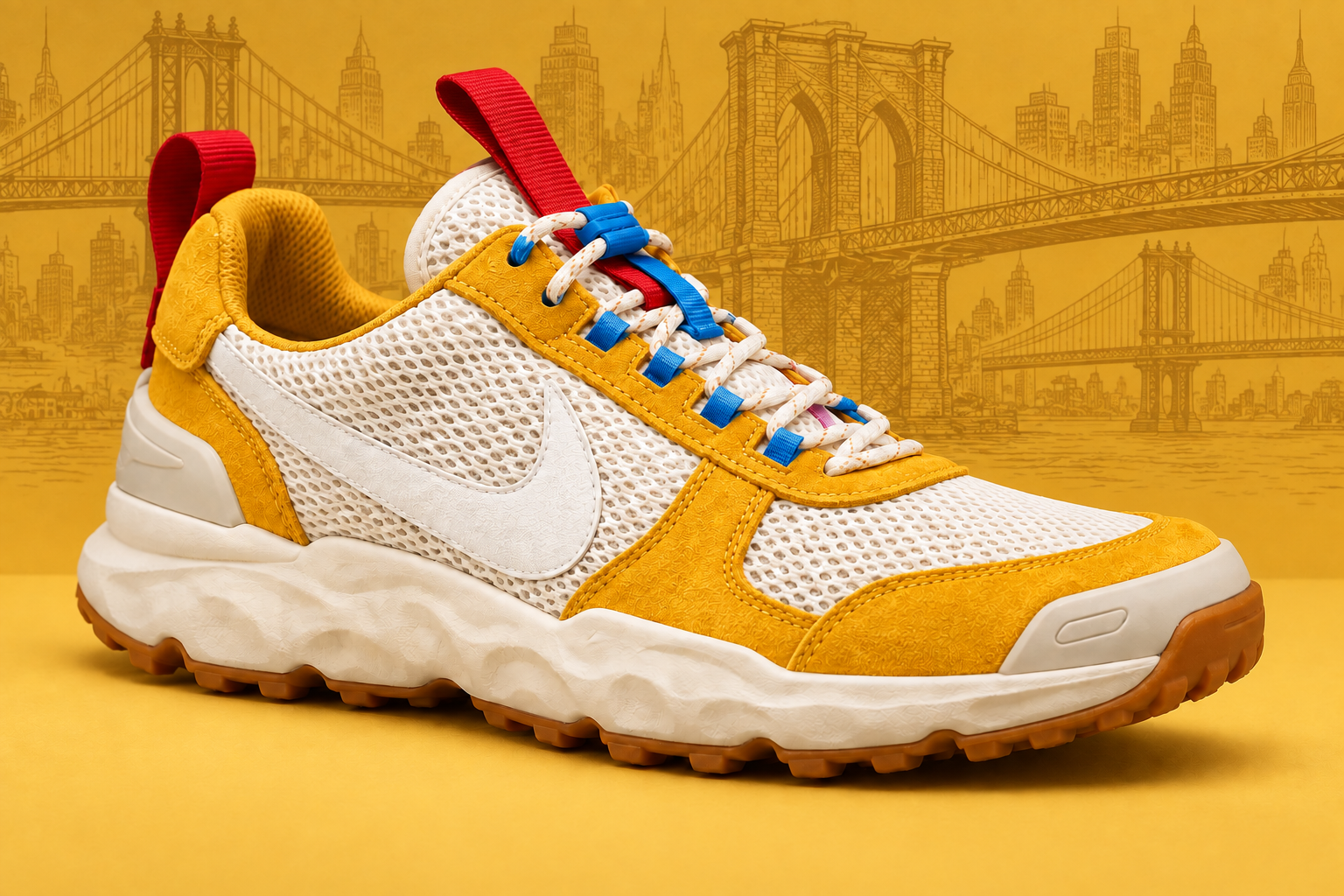
Some sneakers are designed to win races. Others are designed to turn heads. The NikeCraft Mars Yard tries to do both, while asking a more interesting question: what if a shoe were treated as a tool for everyday life—and as a piece of art you could actually wear?
Created through the collaboration between artist Tom Sachs and Nike, NikeCraft is a meeting point between sculpture, product design, and practical footwear. The Mars Yard is its most recognizable expression: a shoe with a space-program origin story, a deliberately work-in-progress look and an audience that reaches from design enthusiasts to fashion insiders.
From the Mars Yard to the street.
The first Mars Yard debuted in 2012. Its starting point wasn’t a runway or a running track, but Sachs’ relationship with NASA engineers and the Mars Yard at NASA’s Jet Propulsion Laboratory in Pasadena—terrain used to plan and test Mars mission work. Sachs drew on materials and ideas connected to that world, including Vectran, a strong, lightweight fiber used in the airbags designed to help a rover land on Mars. The shoe translated that technical reference into something meant to be worn on Earth.
That link between concept and function is central to NikeCraft. The Mars Yard was imagined as equipment for people working in a demanding environment, but its appeal has never depended on performance claims alone. Its look carries the traces of its story: natural colors, visible construction, and a practical, almost prototype-like character.
The 2.0: learning from wear.
The Mars Yard 2.0 arrived in 2017 after Sachs had spent years wearing the original and working with Nike on changes. One lesson came from real use: the Vectran upper, despite its strength, could crease and become fragile with repeated wear. The 2.0 replaced it with tricot mesh and brought other revisions, including stronger stitching around the pull tab, an outsole pattern adapted for city wear, and two insole options.
That process gives the Mars Yard a useful twist on the idea of “innovation.” A material can look advanced on paper and still disappoint in everyday life. Testing a shoe means more than passing a lab test; it means wearing it, noticing what fails and improving the next version. In the Mars Yard story, the scuffs and weaknesses are part of the design conversation.
The 3.0: familiar at first glance, rebuilt underneath.
In July 2025, NikeCraft announced the Mars Yard 3.0, the first new Mars Yard release since 2017. It kept the recognizable visual language, but Nike described the construction as completely new: updated tooling, midsole and outsole, redesigned toe and heel components, and reusable packaging. The technical changes include a natural-rubber outsole, a React foam bed, and a carbon-fiber shank for support and energy return. A redesigned lacing system aims to accommodate a wider range of foot shapes, while TPU pieces add toe protection and heel stability.
This is where the shoe’s minimal-looking exterior becomes more interesting. The Mars Yard doesn’t announce its engineering with bright colors or a crowded set of visual cues. Much of the technology sits beneath the surface, while the silhouette remains recognizable. It feels like a design object revised through use rather than reinvented for novelty.
The fashion appeal: useful, recognizable and intentionally imperfect.
The Mars Yard occupies an unusual place in sneaker culture. Its colors are restrained; its materials can crease, stain, and show wear. Instead of treating those marks as defects, the design invites the possibility that the shoe will develop a history. That makes it easy to style with everyday clothing—from technical pieces to denim and workwear—without relying on a loud logo or a seasonal trend.
Its fashion appeal also comes from the tension between accessibility and scarcity. NikeCraft has described the Mars Yard as a shoe for everyday life, yet access to a new release can be limited. For the 2025 Mars Yard 3.0, NikeCraft connected eligibility to participation in the I.S.R.U. app challenges, built around constructive daily routines. The release turned the path to purchase into part of the project itself.
That approach can build community and give the release a story beyond the product. It can also make the sneaker more desirable to collectors and deepen its status value. Those two effects can coexist: a shoe can encourage people to wear it while also becoming a coveted object. The interesting question is what each owner chooses to do with it.
Exclusive by design, functional by intention.
Exclusivity is part of the Mars Yard’s cultural force, but it is not the whole idea. The shoe’s construction and stated purpose point back to use: a durable outsole, supportive elements, protective components, and a fit system reconsidered for different feet. Its function is everyday rather than specialized; it is not presented as a purpose-built race shoe. NikeCraft’s separate General Purpose Shoe makes that everyday ambition even clearer, describing a simple, adaptable silhouette designed to work across ordinary situations.
That distinction matters. A product can be technically considered without being designed for elite sport, and it can be fashionable without being disposable. The Mars Yard’s appeal sits in that overlap: practical enough to wear, distinctive enough to recognize and conceptually rich enough to talk about.
More than a sneaker drop.
Tom Sachs has described NikeCraft as an art project that allows his studio’s ideas to reach a wider audience through an object people can wear. Nike’s own account of the collaboration frames the Mars Yard as both a sculpture and everyday footwear. That combination helps explain why it resonates with fashion audiences: it offers not just a look, but a point of view about materials, use, and ownership.
The Mars Yard is compelling because it doesn’t ask us to choose between function and meaning. It carries a space-age reference, practical design decisions, and a strong cultural identity in the same pair of shoes. Wear it, mark it, repair it, keep it moving: the best version of the Mars Yard may be the one that stops looking new.
References | Referências
- Nike, “Tom Sachs and NikeCraft Reveal the Continued Innovation of the Mars Yard Sneaker With Mars Yard 3.0” (2025): Nike Newsroom
- Nike, “Why Tom Sachs Created His Latest Version of the NikeCraft General Purpose Shoe” (2026): Nike Magazine
- Nike, “NikeCraft General Purpose Shoe Official Release Date and Info” (2022): Nike Newsroom
- Nike Japan, “Nike and Tom Sachs Announce NikeCraft Mars Yard 2.0” (2017; Japanese-language press release): Nike Japan Archive
- Emily Suzuki, “Tom Sachs Discusses Failure, Selecting Materials and Collaborating with Nike for the Mars Yard Shoe 2.0” (2017): Core77
- Zak Maoui, “Tom Sachs is only just getting started with Nike” (2022): British GQ




Leave a Reply