
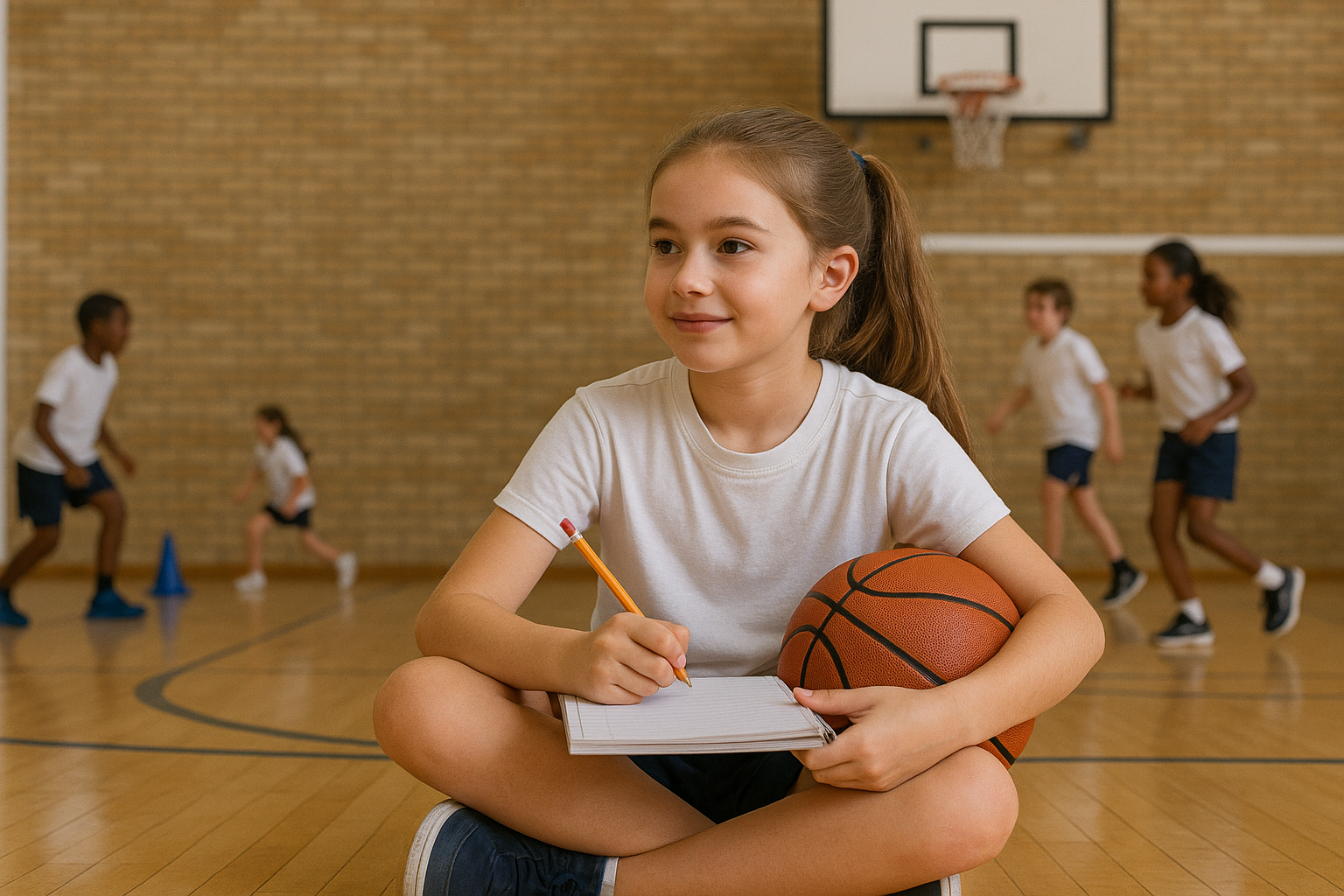
In the rhythm of a game, in the restart after a fall, in the laughter that escapes when learning something new — there lies a powerful principle: that of remaining open to continuous learning. Within the universe of Habits of Mind, this habit is a fertile seed that flourishes exceptionally well in Physical Education practices.
“Remaining Open to Continuous Learning” is more than accepting that we don’t know everything — it’s celebrating it. It allows each experience, each stumble, each victory, and each doubt to make us broader versions of ourselves.
The body as a teacher.
In Physical Education in Elementary School 1, this habit reveals itself with enchanting lyricism. The child who learns to dribble for the first time, who loses his fear of jumping rope, who discovers the right timing for a pass, is experiencing something beyond technique: he is experiencing the beauty of learning with his body, with others, with time.
For our young athletes, being open to continuous learning means embracing the idea that every day presents a new opportunity to improve. It means understanding that there is no end at the finish line — because there will always be another race, another challenge, another game.
Learning to listen to your own body.
In Physical Education classes, students discover that their bodies speak — sometimes they scream, other times they whisper. They learn that fatigue can teach them about limits, that breathing shows their rhythm, and that effort bears fruit. It is in this space that children begin to build autonomy to reflect on themselves, not only as athletes, but as learners of life.
Mistakes as a springboard.
A wrong kick. An imbalance. A slower run than a classmate. All of this can, to the uninitiated, seem like failure. But from the perspective of the learning mindset, they are fundamental parts of the process. Physical Education shows that making mistakes is part of the game — and that beauty lies precisely in trying again, in a new way.
Strategies in pedagogical practice.
To cultivate this habit, the Physical Education teacher can:
- Propose progressive challenges, in which the student surpasses himself, and not just others.
- Encourage reflective feedback, asking: “What did you notice differently in this movement?” or “What did you learn today with your body?”
- Value individual evolution, showing that each person has their own time to blossom, and that the garden is more beautiful precisely because of diversity.
- Record progress, with small logbooks, videos, or drawings of students about their physical and emotional discoveries in class.
Conclusion
Remaining open to continuous learning is accepting that we are eternal learners — and that is pure poetry. Physical Education, with its court-like surface and windy soul, invites each child to discover that the movement of the body is also the movement of the mind. What is learned today does not end knowledge, but opens the doors to tomorrow.
And so, between jumps, falls, and laughter, a generation grows up that knows: learning is not a destination — it is an endless path, full of life.

(PT-BR)
‘Hábitos da Mente’ no contexto da Educação Física: #16 Permanecer Aberto ao Aprendizado Contínuo.

Na cadência de um jogo, no recomeço após uma queda, no riso que escapa ao aprender algo novo — mora ali um princípio poderoso: o de permanecer aberto ao aprendizado contínuo. Dentro do universo dos Habits of Mind, esse hábito é uma semente fértil que floresce especialmente bem nas práticas da Educação Física.
“Remaining Open to Continuous Learning”, ou em português, manter-se aberto ao aprendizado contínuo, é mais do que aceitar que não sabemos tudo — é celebrar isso. É permitir que cada vivência, cada tropeço, cada vitória e cada dúvida nos torne versões mais amplas de nós mesmos.
O corpo como professor.
Na Educação Física do Ensino Fundamental 1, esse hábito se revela com um lirismo encantador. A criança que aprende a driblar pela primeira vez, que perde o medo de pular corda, que descobre o tempo certo do passe, está vivenciando algo além da técnica: está experimentando a beleza de aprender com o corpo, com os outros, com o tempo.
Estar aberto ao aprendizado contínuo é, para nossos pequenos atletas, aceitar que todo dia é uma nova chance de fazer melhor. É entender que não existe fim na linha de chegada — porque sempre haverá outra corrida, outro desafio, outra brincadeira.
Aprender a escutar o próprio corpo.
Nas aulas de Educação Física, o aluno descobre que seu corpo fala — às vezes grita, outras sussurra. Ele aprende que a fadiga pode ensinar sobre limites, que a respiração mostra o ritmo e que o esforço rende frutos. É nesse espaço que a criança começa a construir autonomia para refletir sobre si mesma, não só como atleta, mas como aprendiz da vida.
Estratégias na prática pedagógica.
Para cultivar esse hábito, o professor de Educação Física pode:
- Propor desafios progressivos, em que o aluno se supere em relação a si mesmo, e não apenas ao outro.
- Estimular o feedback reflexivo, perguntando: “O que você percebeu diferente nesse movimento?” ou “O que você aprendeu hoje com seu corpo?”
- Valorizar a evolução individual, mostrando que cada um tem seu tempo de florescer — e que o jardim é mais bonito justamente pela diversidade.
- Registrar o progresso, com pequenos diários de bordo, vídeos ou desenhos dos alunos sobre suas descobertas físicas e emocionais nas aulas.
Conclusão
Permanecer aberto ao aprendizado contínuo é aceitar que somos eternos aprendizes — e isso é poesia pura. A Educação Física, com seu chão de quadra e alma de vento, convida cada criança a descobrir que o movimento do corpo é também o movimento da mente. Que o que se aprende hoje não encerra o saber, mas abre as portas para o amanhã.
E assim, entre pulos, tombos e risadas, cresce uma geração que sabe: aprender não é um destino — é um caminho sem fim, cheio de vida.


Leave a Reply